
Unclaimed Airdrops: Why Coins Go Unclaimed and How to Find Yours
An airdrop is a project giving coins or tokens to people who used it early. It sounds like free money arriving in your wallet. In practice, most airdrops don't arrive by themselves. The project publishes who is eligible, and each person has to go and claim. A large share of people never do.
Those allocations are called unclaimed airdrops. This article looks at how big the gap is, why it happens, what projects do with the coins nobody claimed, and how to check whether an old wallet of yours is one of them.
How many airdrops go unclaimed?
The numbers are public, because the claim contracts are public.
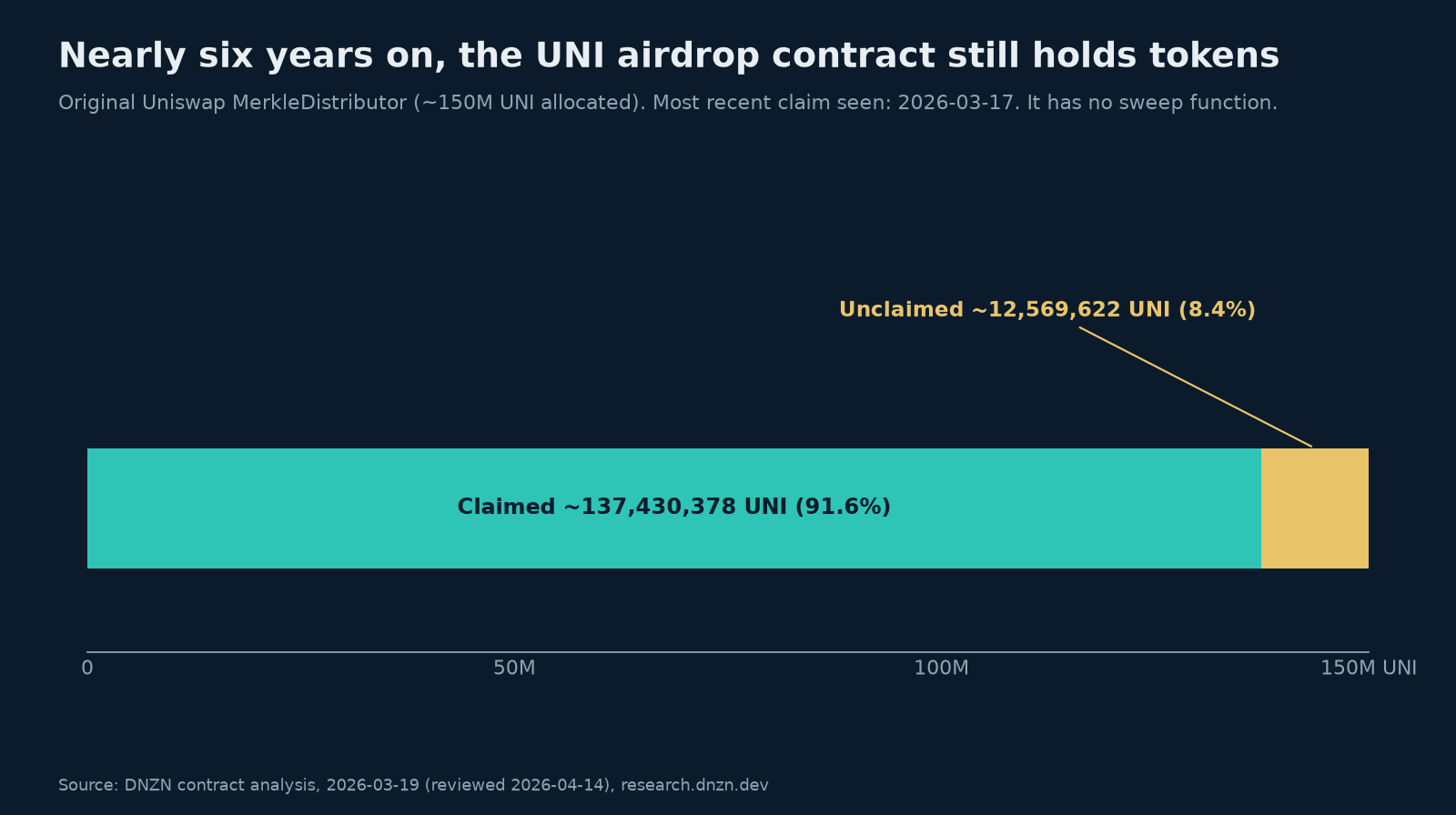
Uniswap (UNI), 2020. Uniswap gave 400 UNI to every address that had used its v1 or v2 contracts before September 1, 2020 (official announcement). An analysis of the original distributor contract in March 2026 found about 12,569,622 UNI, roughly 8.4% of the allocation, still unclaimed nearly six years later. The contract has no function to sweep those tokens away.
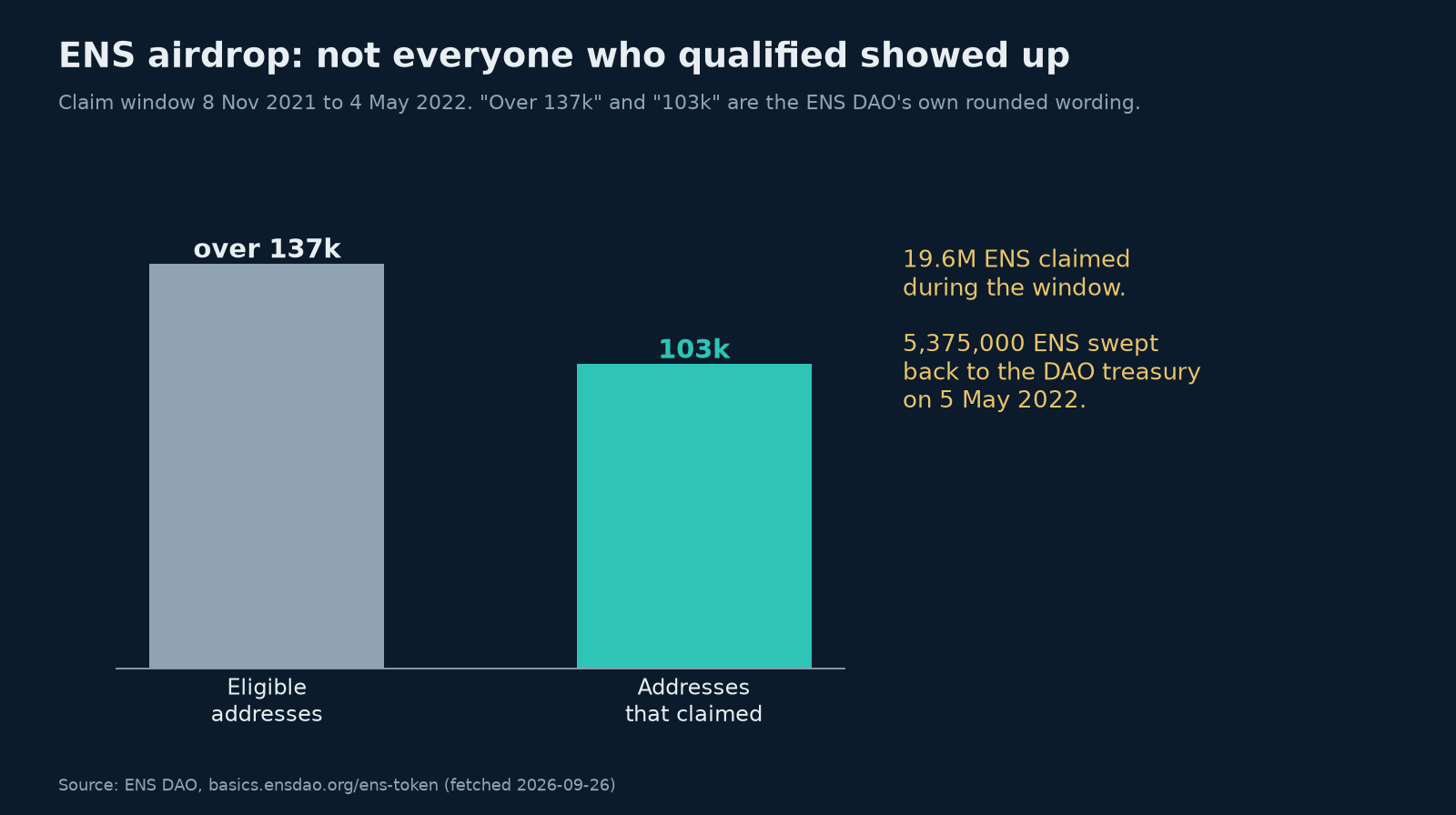
ENS, 2021. The ENS DAO says more than 137,000 addresses were eligible for its airdrop, and 103,000 of them claimed. When the window closed on May 4, 2022, 5,375,000 unclaimed ENS were swept back to the DAO treasury (ENS DAO).
Arbitrum (ARB), 2023. About 93% of eligible users claimed, according to Dune data cited by Cointelegraph. After the deadline of September 24, 2023, the Arbitrum Foundation said the unclaimed tokens, 69,448,385 ARB, had been moved to the Arbitrum DAO treasury (The Block).
Even a few percent of a large airdrop is a lot of coins. CoinGecko estimates the 50 biggest airdrops from 2020 to December 2023 at $26.6B combined, valued at each coin's all-time-high price, not at today's price or at what recipients received (CoinGecko).
Why coins go unclaimed
There is rarely one reason. These are the common ones.
People never hear about it. Airdrops are announced on a project's blog and social accounts. If you used an app once in 2020 and stopped following crypto news, you may simply have missed it.
The wallet was forgotten. Many people created a wallet on an old phone or computer, used it a few times, and moved on. The address can still be eligible years later.
The fee looked too high. Claiming is a transaction, and on Ethereum mainnet that costs a network fee in ETH. When fees were high, some people decided a small allocation wasn't worth it, and never came back.
The window closed. Many programs give a few months to claim. Busy people miss deadlines.
Fear of scams. Fake claim sites are everywhere, so some people sensibly decided not to click anything. Without a safe way to check, they left the claim alone.
What happens to unclaimed airdrops
It depends on how the program was built.
- No deadline. Some claim contracts, like the 2020 UNI distributor, stay open. An eligible address that never claimed can still do so on the project's official app.
- Deadline, then swept. Many programs move the leftover tokens after the window closes, usually to a DAO treasury, as ENS and Arbitrum did. After that, there is nothing left to claim.
- Sent directly. Occasionally a project sends unclaimed tokens straight to eligible addresses. Optimism did this in September 2023 with about 48 million OP from its first airdrop, which went to about 88,000 eligible addresses. In that case the tokens may already be in the wallet, even though the owner never claimed.
So "unclaimed" doesn't always mean "still available." A useful check tells you two things: whether your address had an allocation, and whether the program is still open.
How to find unclaimed airdrops in your own wallet
1. Find your public address
You need the wallet's public address, the long string that starts with 0x. In MetaMask, Trust Wallet or the Base app, it is shown under Receive, with a copy button. The public address is safe to look up, because it is already visible to anyone on the blockchain.
If you only ever used an exchange account, the deposit address there is usually managed by the exchange, and results for it may not apply to you. For those, check the exchange's official help pages.
2. Never use the seed phrase
Your seed phrase (recovery words) and private key are the keys to the wallet. No checking tool needs them. Anyone who asks for them to "find your airdrops" is trying to steal from you.
3. Check the address against the official sources
For a single project, use the checker on its official site, reached from its own documentation or verified accounts. For many projects at once, use a tool that reads the official lists for you. Our guide on how to check if your wallet is eligible for an airdrop walks through this step by step.
4. Look beyond airdrops
Old wallets often hold forgotten deposits too: a balance in Aave or Compound, shares in a Yearn vault, rewards in Curve or Convex, or a Uniswap liquidity position. These don't always appear in a wallet app's token list.
5. Confirm before you claim
If something turns up, open the project's official site yourself, check the deadline, and compare the network fee with the amount. Read every wallet request before approving it.
Checking an old wallet with PoolIndex
PoolIndex is an airdrop checker for Windows and Android. You paste a public 0x address, and it checks public airdrop and claim sources on Ethereum, Arbitrum One, Optimism, Base and Polygon. For the Uniswap, ENS, CoW Protocol, dYdX, Safe, Arbitrum and ZORA airdrops it looks up the address itself and shows whether the allocation was claimed, and closed programs are marked as closed. It also checks balances and old DeFi positions. There is more on what it covers on the unclaimed airdrops page.
- You only enter your public address.
- PoolIndex never asks for your seed phrase or private key.
- Each result shows the network and how it was checked, and airdrop results link to their official source.
- Sources that failed are listed as failed, not hidden.
A result is a research lead, not a promise of funds. Always confirm on the project's official site.
Check your old wallet: get PoolIndex from the Microsoft Store for Windows, or get it on Google Play. Free after you register: check 1 wallet and 5 links a month.
Frequently asked questions
What are unclaimed airdrops?
They are airdrop allocations that exist on a project's official list but were never claimed by the address owner. The coins stay in the claim contract until someone claims them, or until the project moves them after a deadline.
Can I still claim an old airdrop?
Sometimes. Programs without a deadline, such as the 2020 UNI airdrop, can still be claimed by eligible addresses. Programs with a deadline, such as ENS and Arbitrum, cannot.
Where do unclaimed airdrop tokens go?
It depends on the program. Many projects sweep them to a DAO treasury after the deadline. Some leave the contract open, and a few send the tokens directly to eligible addresses.
Is it safe to check an old wallet for unclaimed airdrops?
Checking a public address is safe, because it only reads public information. Never type the wallet's seed phrase or private key into any site or app to check for airdrops.
Someone offered to recover my unclaimed airdrop for a fee. Is that real?
Treat it as a scam. Nobody can claim an allocation for you without your wallet's keys, and nobody can reopen a program that has closed.
Sources
- Uniswap, "Introducing UNI" (retrieved 2026-10-21): https://blog.uniswap.org/uni
- DNZN, contract analysis of the Uniswap MerkleDistributor (2026-03-19, reviewed 2026-04-14): https://research.dnzn.dev
- ENS DAO, "$ENS Token" (retrieved 2026-09-26): https://basics.ensdao.org/ens-token
- Cointelegraph, "Arbitrum DAO takes $56 million of unclaimed ARB tokens" (September 25, 2023): https://cointelegraph.com/news/arbitrum-dao-takes-56million-of-unclaimed-arb-tokens
- The Block, Arbitrum DAO unclaimed airdrop (September 25, 2023): https://www.theblock.co/post/252727/arbitrum-dao-unclaimed-airdrop
- CoinGecko, "Biggest Crypto Airdrops" (updated April 30, 2026): https://www.coingecko.com/research/publications/biggest-crypto-airdrops
- ForkLog, Optimism distribution of unclaimed OP (September 18, 2023), as cited in PoolIndex's chart of unclaimed airdrop outcomes