
How to check a wallet address without connecting it
Nearly six years later, people are still claiming the UNI airdrop. Millions of airdropped tokens have sat unclaimed for years. Here is how big that gap is, how to check a wallet address using read-only tools, and why "just connect your wallet to check" is the wrong way to close it.
The lede: a contract that never closes
On 16 September 2020, Uniswap Labs announced that 150,000,000 UNI could be claimed right away by past users, liquidity providers and SOCKS holders. The terms were simple: "400 UNI are claimable by each address that has ever called the Uniswap v1 or v2 contracts." That covered 251,534 historical user addresses and 49,192 liquidity providers.
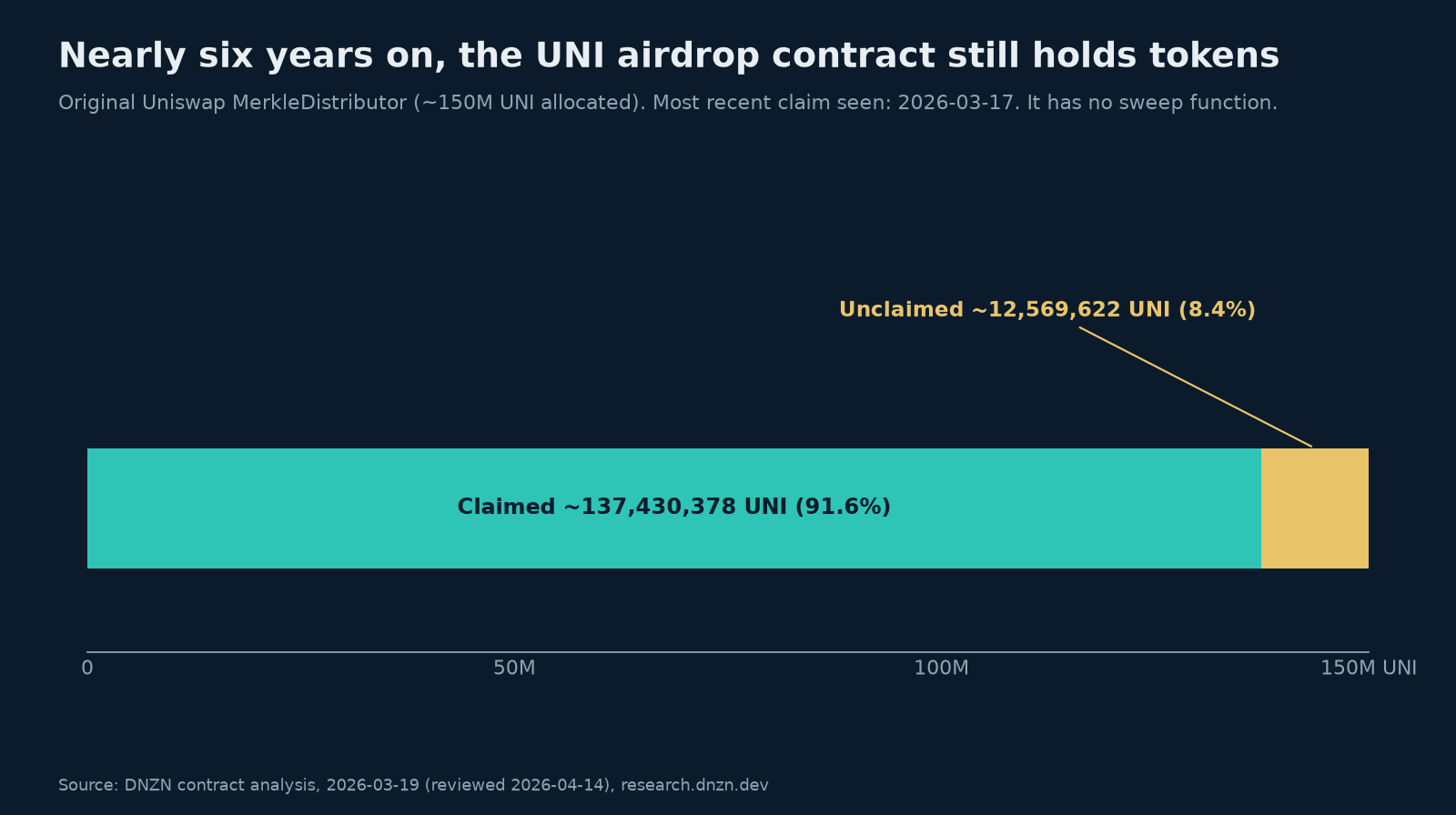
The claim contract behind that announcement, a Merkle distributor, has no owner, no admin key and no sweep function. As a result, a 2026 contract analysis by DNZN found something unusual. Approximately 12.57 million UNI (about 8.4% of the allocation) is still sitting in it. Claims were still arriving as recently as 17 March 2026, across roughly 31,500 transactions over nearly six years.
KEY FIGURE
~12,569,622 UNI still unclaimed in the original distributor, per DNZN's analysis of 19 March 2026.
UNI is not an isolated case. It is simply the one where the door never closed.
Finding 1: The sums were large, at least at peak
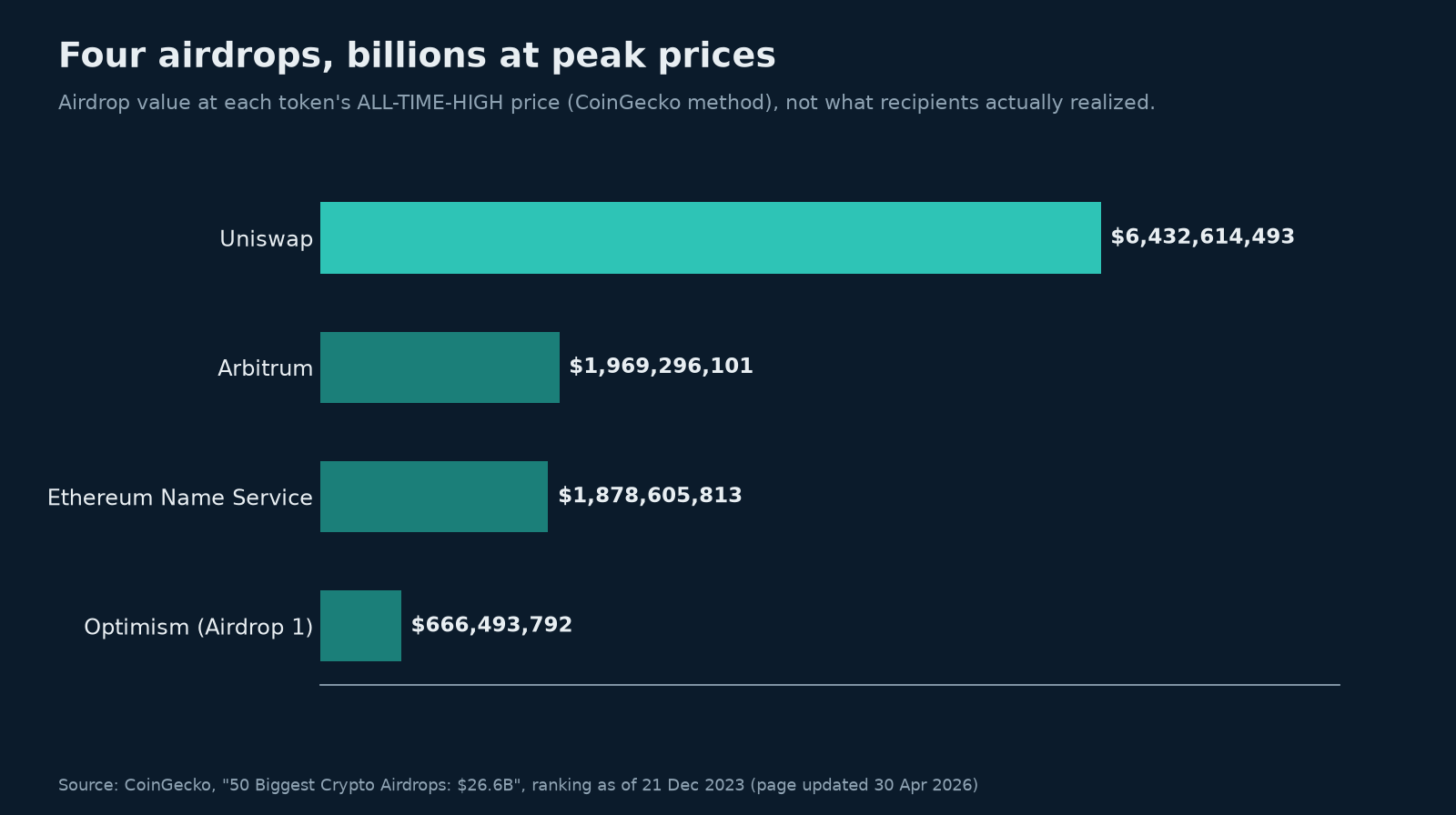
CoinGecko's ranking of the 50 biggest airdrops puts their combined value at $26.6 billion. That is based on each token's all-time-high price, so it describes peak value, not what recipients actually took home. On the same basis, Uniswap's drop was worth $6.43 billion, Arbitrum's $1,969,296,101, ENS's $1,878,605,813 and Optimism's first airdrop $666,493,792.
A separate estimate points the same way. According to CoinDesk, reporting on 11 March 2025 on a Dragonfly study, a sample of 11 major airdrops "generated over $7.16 billion since 2020."
Finding 2: A large share of eligible addresses never claimed their airdrops
The official numbers show a consistent gap between who qualified and who showed up:
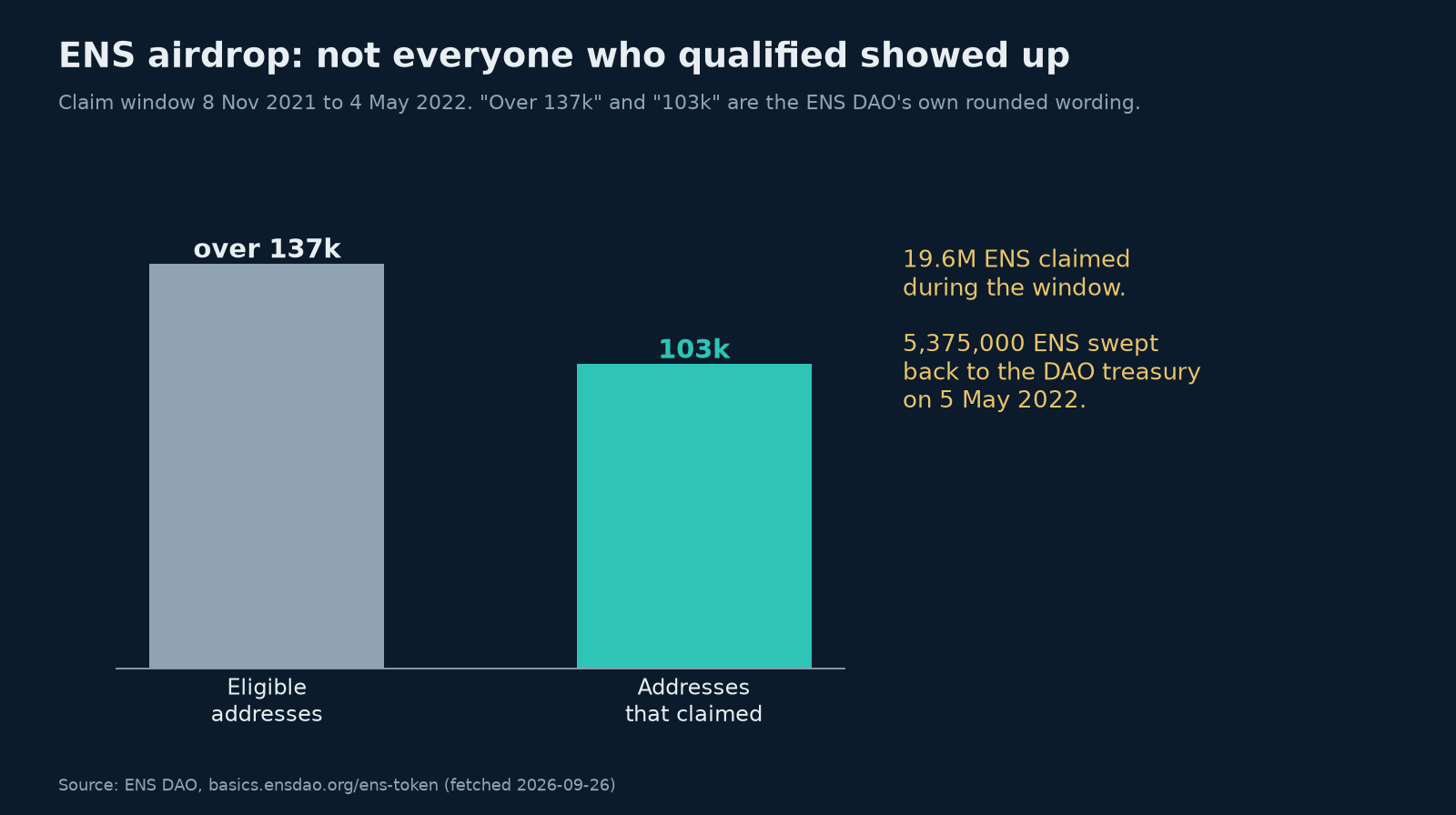
- ENS. The ENS DAO reports that "over 137k addresses were eligible," but "19.6 million $ENS tokens were claimed during the airdrop window by 103k eligible addresses."
- Arbitrum. According to Cointelegraph, reporting on 25 September 2023 and citing Dune data, "93% of eligible users had claimed the tokens." That was a high rate, and it still left 69,448,385 ARB in the claim contract at the deadline, as The Block reported the same day.
- Optimism. According to The Block, reporting on 25 September 2023, "around 49 million ($61.7 million) of its OP tokens remained unclaimed from an airdrop of 215 million tokens." ForkLog put it this way: "about a quarter of addresses eligible to receive the assets did not claim them."
- Starknet. The Starknet Foundation lists 1,297,738 eligible addresses for its first Provisions round. StarkWare's Margaret Weiss wrote on 3 July 2024 that "roughly 500M tokens were claimed, leaving roughly 400M STRK tokens for future rounds."
Finding 3: Unclaimed tokens usually end up somewhere else
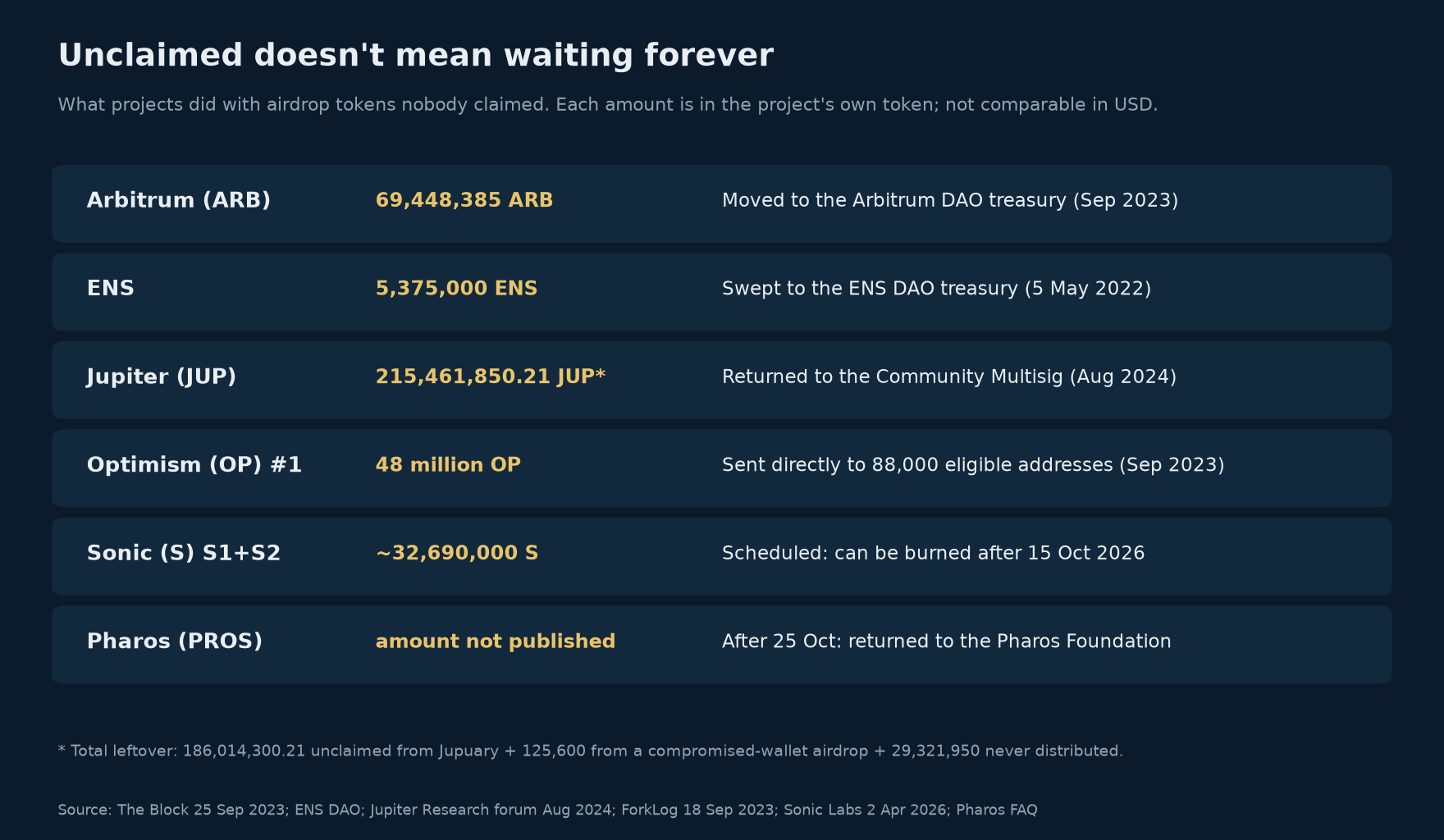
The UNI contract is the exception. Most programs set a deadline, and what happens after it varies:
- Arbitrum moved the leftover ARB to its DAO treasury. The foundation's message, as quoted by The Block, was blunt: "You cannot claim those tokens anywhere. Please be safe out there."
- The ENS DAO swept 5,375,000 ENS back to its treasury on 5 May 2022.
- A post in Jupiter's community audit thread reports (2 August 2024) 215,461,850.21 JUP "returned to the Community Multisig" after the January 2024 airdrop.
- Optimism went the other way and sent 48 million unclaimed OP directly to 88,000 eligible addresses, ForkLog reported on 18 September 2023.
- Sonic says (2 April 2026) approximately 32,690,000 S from its first two seasons can be burned after 15 October 2026.
PULL QUOTE
"You cannot claim those tokens anywhere. Please be safe out there." (Arbitrum Foundation, quoted by The Block, 25 September 2023)
That last line from Arbitrum matters. After a deadline passes, anyone still offering a way to "claim" is, by the project's own account, lying.
Finding 4: The same gap is what scammers exploit (is it safe to connect your wallet?)
Unclaimed value creates a market for fake claim pages. Scam Sniffer counted $83.85 million lost to wallet-drainer phishing on EVM chains in 2025, across 106,106 victims, and calls that figure a lower bound (report dated 3 January 2026). The pattern in drainer research is consistent: the victim is asked to connect a wallet and sign something. A BlockSec summary (21 October 2025) of academic research found that drainer affiliates lure victims "through social media, fake airdrops, and compromised accounts."
So the useful question isn't whether to check an old address. It's how to check one without handing anyone a signature.

How to check a wallet address: a read-only method
1. Your public wallet address is already public data
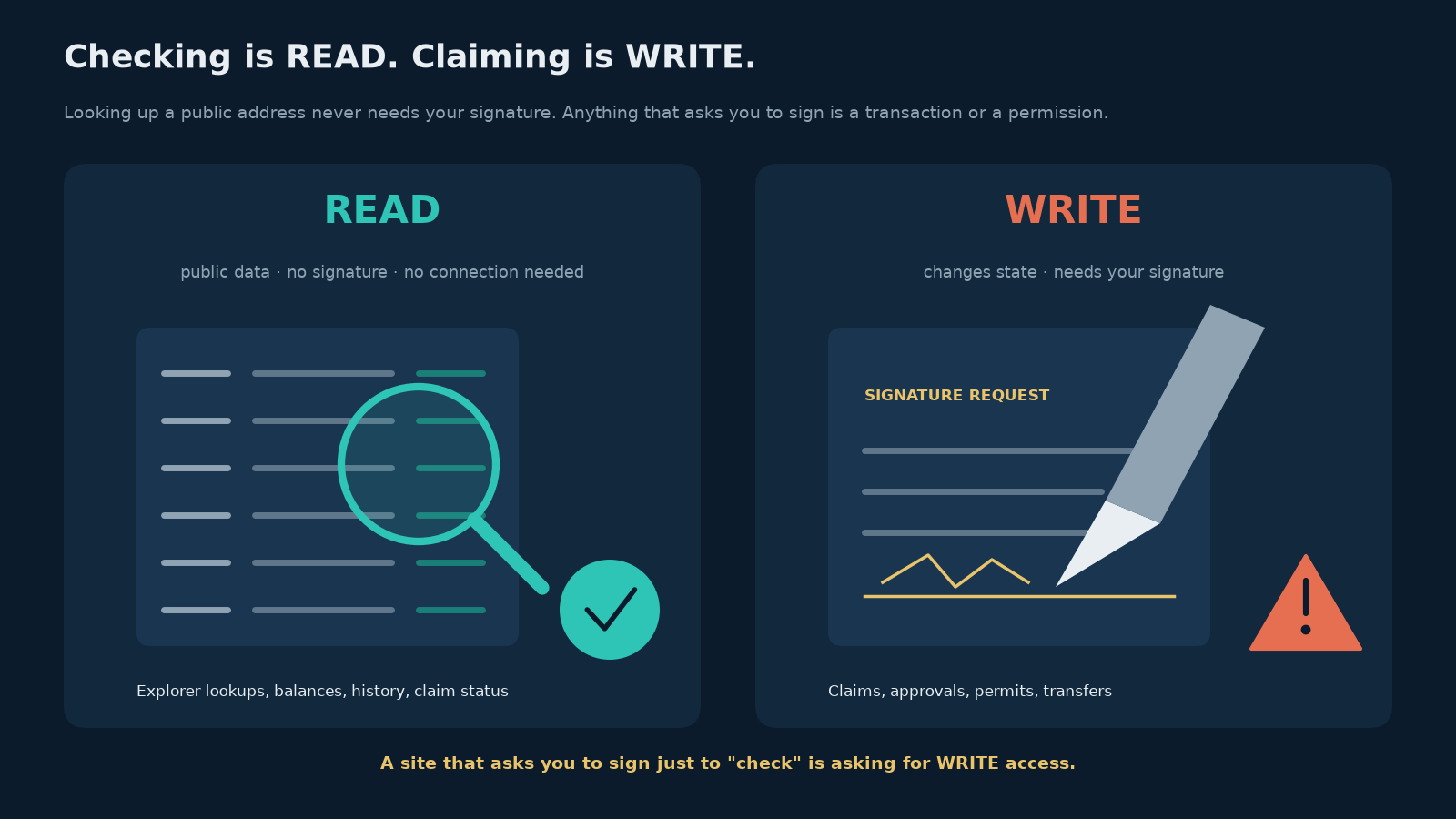
Anything you can learn about an address can be read from the address alone. Balances, past transactions, token holdings and whether an allocation in a published Merkle distributor has been claimed are all public reads. A page that says it needs your wallet connected "to check eligibility" doesn't need that to read anything. See why checking an address shouldn't need your signature.
2. Check wallet address history on a block explorer
Paste the address into Etherscan and the explorers for any L2s you used. Check the wallet address transactions, token balances, old LP tokens and staked positions, and look at incoming token transfers to see past airdrops you already received. This is read-only. Step by step: how to read an Ethereum address on Etherscan.
3. Check airdrop eligibility and status at the official source
Find the project's own announcement or docs, like the Uniswap post or the ENS DAO docs cited above, and check whether the window is still open. If it closed, no website can reopen it. More on what happens when a claim window closes.
4. For Merkle distributors, read the contract rather than a stranger's site
Many distributors expose a read function (often isClaimed) on the explorer's "Read Contract" tab. You don't need to connect a wallet to use it. Background: what is a Merkle airdrop?
5. Treat protocol leftovers separately when you look for unclaimed crypto
Unclaimed lending rewards or uncollected LP fees live in the protocol's own contracts, not in airdrop lists. See protocol leftovers that aren't airdrops.
6. If something real turns up, claim only through the official interface
Type the URL yourself and read every signature request before approving it. Before you click anything, read how to spot a fake airdrop website, and check your token approvals while you're there.
RED FLAGS WHILE CHECKING
A signing prompt on a page that only claims to "check" · a request for a seed phrase or private key (no legitimate checker needs one) · a token you never bought with a website in its name · "support" accounts offering to help you claim · a claim link from a reply, DM or ad.
Where PoolIndex fits
Disclosure: PoolIndex publishes this guide.
PoolIndex is a research tool for Windows and Android for public crypto claims. You paste a public 0x address and it searches dozens of trusted public sources. Each result shows the network and how it was checked, and airdrop results link to their official source. If a source fails or times out, that failure is shown, not hidden or turned into a "no." "Nothing found, and here's what was checked" is a normal result, and PoolIndex can't promise there's anything to find.
It can also research a link before you open it, showing what was found on that URL with the evidence and source for each finding.
PoolIndex checks using your public wallet address only, the same address anyone can already see on the blockchain. It never asks for your seed phrase or private key, so it has nothing that could move your funds.
See how PoolIndex works. Get it from the Microsoft Store (Windows) or on Google Play (Android). Free after you register: check 1 wallet and 5 links a month. Windows and Android.
FAQ
How do I check a wallet address without connecting it?
Paste the public address into a block explorer such as Etherscan (and the explorer for each L2 you used) to read balances, history and token transfers. For airdrops, confirm the window on the project's official page. You don't need to connect a wallet to check a public address.
Is it safe to connect my wallet to check for an airdrop?
You don't need to. Eligibility and claim status are public data. You only need a wallet to claim, and only on the project's official interface. A page that asks you to connect or sign just to "check" is a red flag.
How do I check airdrop eligibility?
Start from the project's own announcement, docs or verified account, and check whether the window is still open. For Merkle distributors, the contract's read functions on a block explorer can show claim status from the public address alone.
How can I find unclaimed airdrops or unclaimed crypto?
Check each chain's explorer for old balances, LP tokens and staked positions, then check official project pages for claim windows. Rewards or uncollected fees sit in the protocol's own contracts, not in airdrop lists.
Can you see past airdrops for a wallet address?
Tokens an address already received show up in its token-transfer history on the explorer. Whether an allocation was left unclaimed has to be checked against the project's official sources or distributor contract.
Is it safe to paste my wallet address into a checker?
A public address can already be read by anyone on a block explorer. The risk is what a site asks for next: a signature, a seed phrase or a private key. No read needs any of those.
Do unclaimed airdrops stay claimable forever?
Usually not. ENS and Arbitrum moved leftovers to their DAO treasuries, Sonic has set a burn date, and Pharos says unclaimed tokens return to its foundation. Uniswap's original distributor is an exception because it has no sweep function.
Does a remaining balance in a distributor mean I can claim it?
No. A contract balance says nothing about any particular address.
Sources
- Uniswap Labs, "Introducing UNI" (16 Sep 2020; fetched 2026-09-26): https://blog.uniswap.org/uni
- DNZN, Uniswap MerkleDistributor contract analysis (2026-03-19, reviewed 2026-04-14; re-verified 2026-10-02): https://research.dnzn.dev/contracts/uniswap/merkle-distributor/contract-analysis/
- CoinGecko, "50 Biggest Crypto Airdrops: $26.6B" (ranking as of 21 Dec 2023, page updated 30 Apr 2026; fetched 2026-09-26): https://www.coingecko.com/research/publications/biggest-crypto-airdrops
- CoinDesk, Ian Allison, "U.S. Residents Missed as Much as $2.6B in Potential Revenue From Geoblocked Airdrops" (11 Mar 2025; fetched 2026-09-26): https://www.coindesk.com/business/2025/03/11/venture-capital-firm-dragonfly-weighs-cost-of-geoblocked-airdops-to-u-s-crypto-holders
- ENS DAO, $ENS Token (undated docs; fetched 2026-09-26): https://basics.ensdao.org/ens-token
- Cointelegraph, Helen Partz, "Arbitrum DAO takes $56M of unclaimed ARB as airdrop deadline ends" (25 Sep 2023; fetched 2026-09-26): https://cointelegraph.com/news/arbitrum-dao-takes-56million-of-unclaimed-arb-tokens
- The Block, James Hunt, "Arbitrum DAO treasury boosted by $57 million in unclaimed airdrop tokens" (25 Sep 2023; fetched 2026-09-26): https://www.theblock.co/post/252727/arbitrum-dao-unclaimed-airdrop
- ForkLog, "Optimism distributes unclaimed OP tokens worth $67 million" (18 Sep 2023; fetched 2026-09-26): https://forklog.com/en/optimism-distributes-unclaimed-op-tokens-worth-67-million/
- Starknet FAQ (undated; fetched 2026-09-26): https://www.starknet.io/faqs/
- StarkWare, "Airdrop Reflections" (3 Jul 2024; fetched 2026-09-26): https://starkware.co/integrity-matters-blog/airdrop-reflections/
- Jupiter Research forum, JUP Community Audit (2 and 8 Aug 2024; re-verified 2026-10-02): https://discuss.jup.ag/t/jup-community-audit-jul-2024/20810?page=2
- Sonic Labs, "Sonic Airdrop Burn and Final Claim Deadline" (2 Apr 2026; re-verified 2026-10-02): https://www.soniclabs.com/blog/sonic-airdrop-burn-and-final-claim-deadline/
- Pharos airdrop FAQ (undated; re-verified 2026-10-02): https://claim.pharos.xyz/faqs
- Scam Sniffer 2025 report (3 Jan 2026; re-verified 2026-10-02): https://drops.scamsniffer.io/scam-sniffer-2025-crypto-phishing-losses-fall-83-to-84-million/
- BlockSec on Drainer-as-a-Service (21 Oct 2025; fetched 2026-09-26): https://blocksec.com/blog/inside-ethereum-s-shadow-economy-new-research-unmasks-the-135-m-drainer-as-a-service-industry